2026
Exhibition
PS122
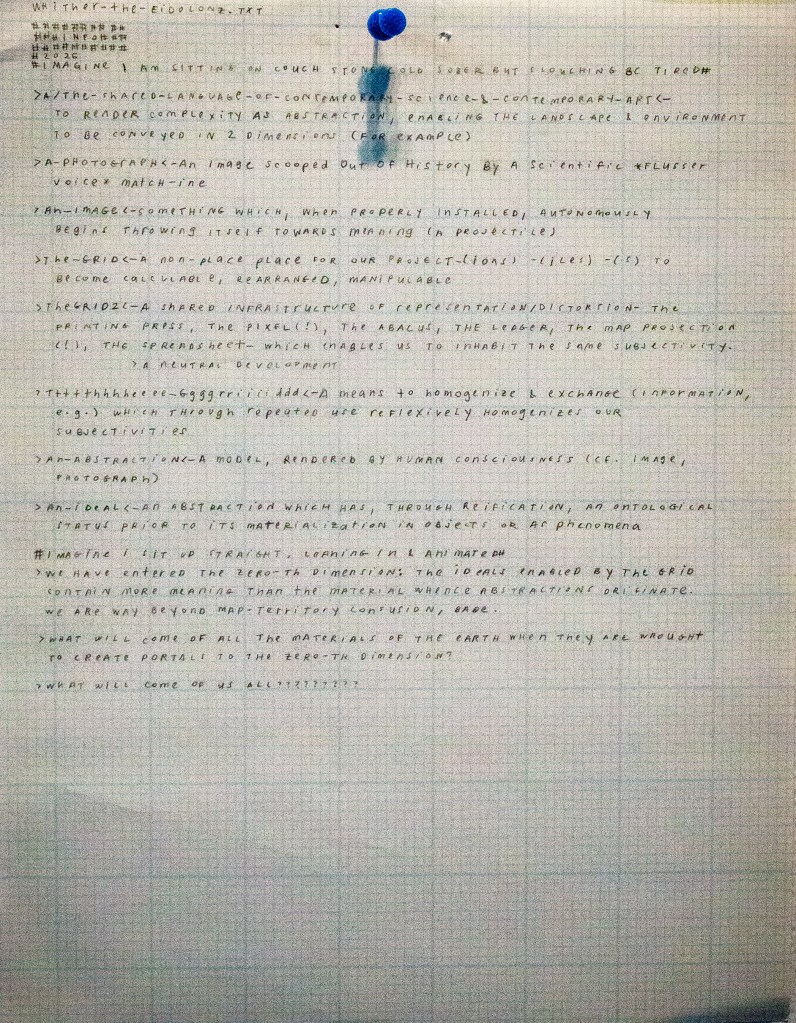
whither-the-eidolonz.txt
graphite on Gridded PAper
2026
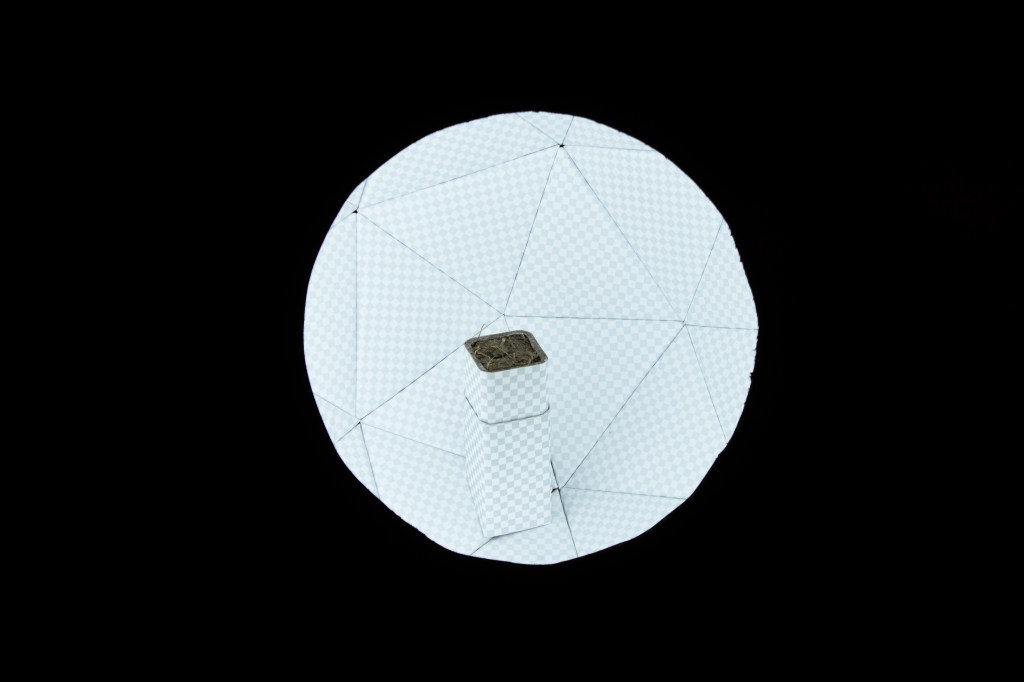
Nonvirtual nonsite
Soil from Linn county, Iowa, cardboard, vinyl, LED lights, spray paint, steel
2026
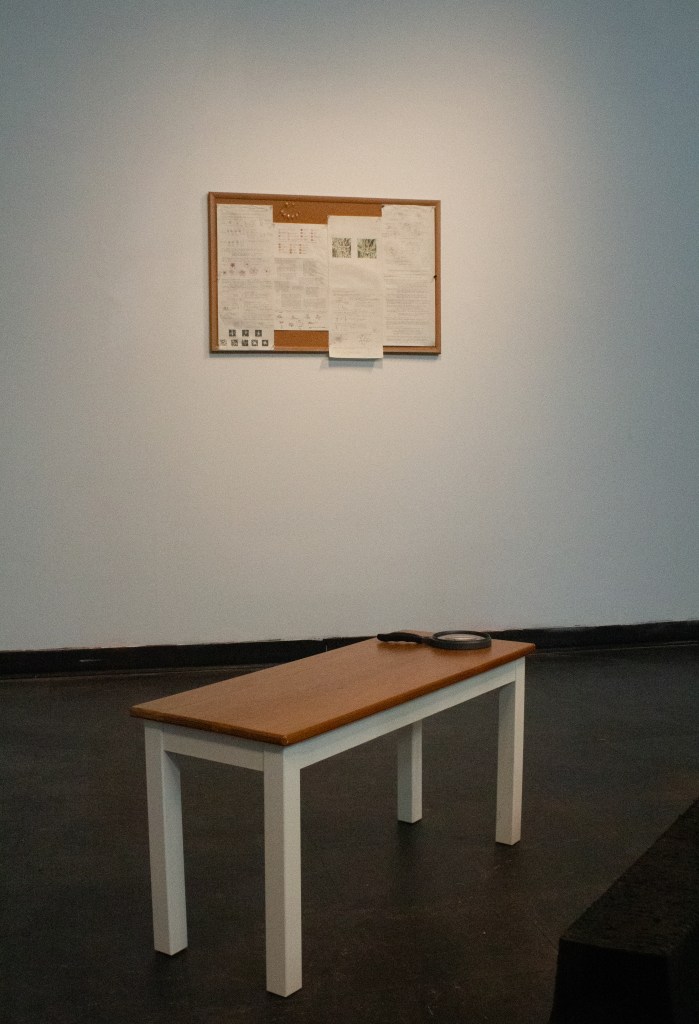
Bolus: what does it mean to make an immaterial orchid? Initial notes in preparation for an (im)material investigation and ecological experiment
Graphite and wax crayon on gridded paper, corkboard, push pins, magnifying glass
2025
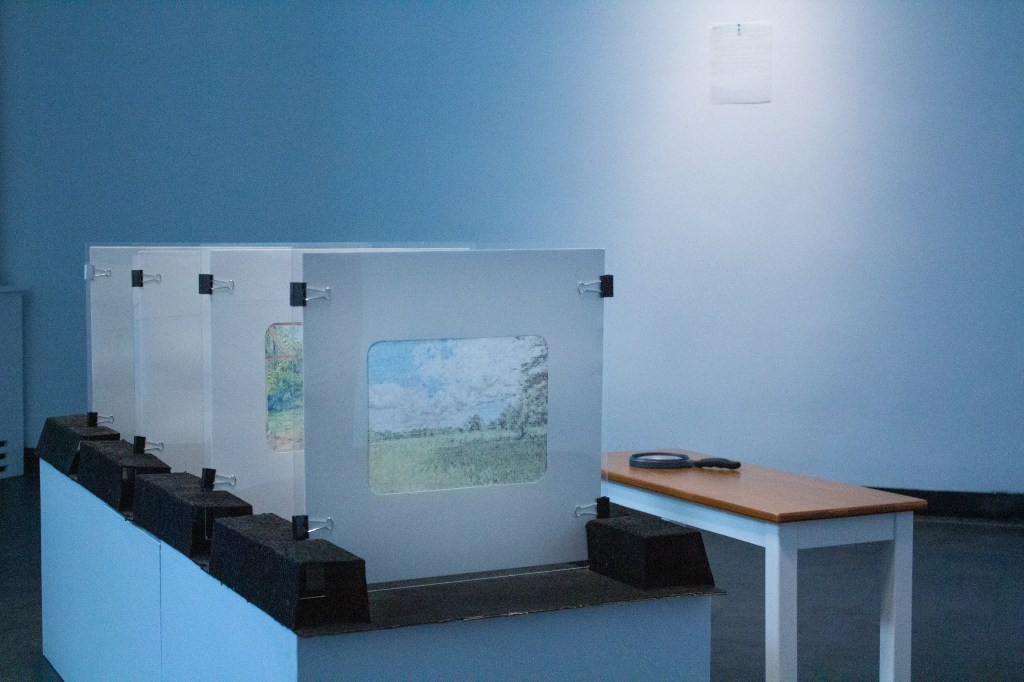
Landscape Projector
Cardboard, crayon and graphite on gridded paper, museum board, spray paint, archival tape
2026
As the world allegedly hurtles towards an imminent apocalypse, science and technology are either characterized as panaceae of innovation that will provide perfectly optimized solutions to all of our problems, or an opened pandora’s box reaching critical mass. All the TO-BEs That Are Already Being Known presents three artists with research-based practices that explore, confront, and problematize the contemporary state of Scio-Techne-Knowledge production. Spanning drawing, sculpture, and multimedia installation, the works in this exhibition eschew these normative notions and instead divulge the systems, hierarchies, and paradigms siloed by contemporary technoscience by positioning art as a methodology for investigation and entanglement.
Frank Haotian Cong’s work began with the observation that the bodies of laborers, along with the diverse crops and microbes native to a landscape, are largely absent from the “fast fermentation” reliant on commercially available flour and yeast. The lingua franca that frames fermentation as either cellular manufacturing or symbiosis seems inadequate to account for the complexity of these cultural and material interactions. Through endurance performance and installation, Frank employs extreme contact and intensified sensory experience to confront such absence and simplification. He also has baked some sunset for everyone.
In The Dispossession of B.H., Brian Hudson Huang releases robots that slither/crawl across the floor, haunting/infesting the gallery. Neither completely organic, machine, insectoid, or reptilian, they instead are merely observers of the world around them, and react accordingly. Drawing from contemporary anxieties of robotics instrumentalized for war, surveillance, and companionship, these robots blur the line between the autonomy of self-contained beings and their possible interactions and consequences in the lifeworld.
Aubrie James’s drawings, diagrams, and sculptures call attention to the grid and modularity as conceptual and aesthetic principles organizing biological inquiry, digital imagery, and information technology. Diagrams, notes, drawings, and graphs—alongside a piece of earth from the contested site of a future data center—surface the interaction of models, memories, and images of landscapes from the (subliminal, ubiquitous) grid, questioning the quantitative translation of life. Together, these works ask after the kaleidoscopic profusion of land imagery to explore quantitative capture, meat-versus-silicon-memory, and the mass-mediations of landscape(s).
 aubrie's bounce zone