Bolus: what does it mean to make an immaterial orchid? Initial notes in preparation for an (im)material investigation and ecological experiment
2025
Graphite and wax crayon on gridded paper. 23” x 32”
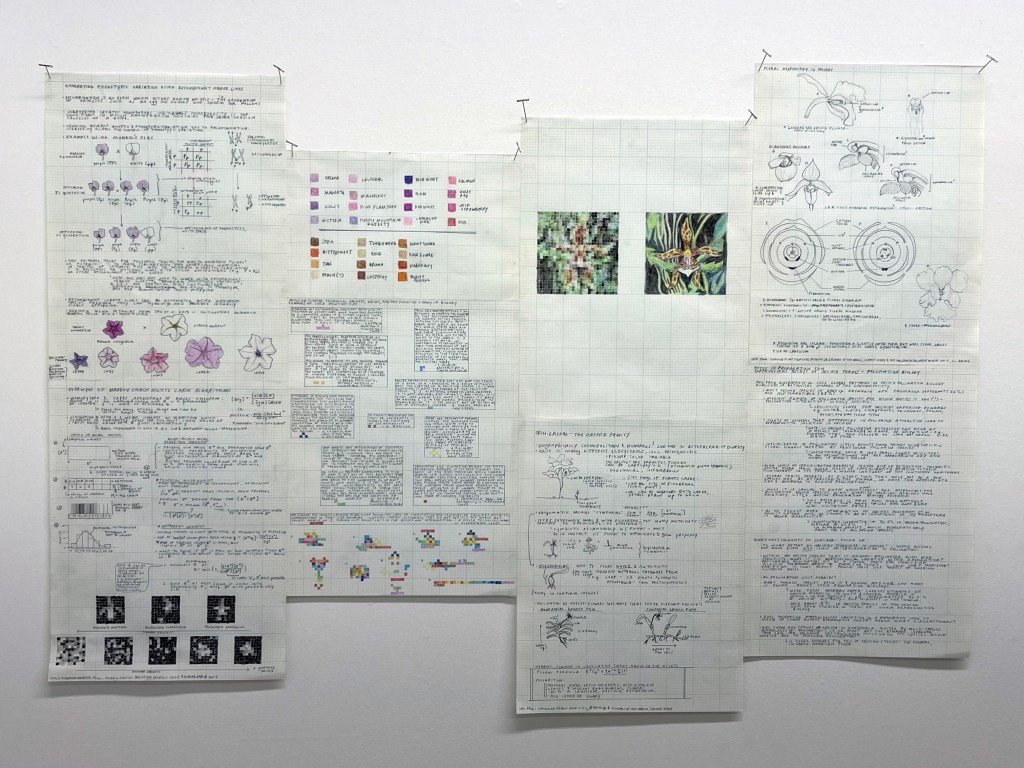
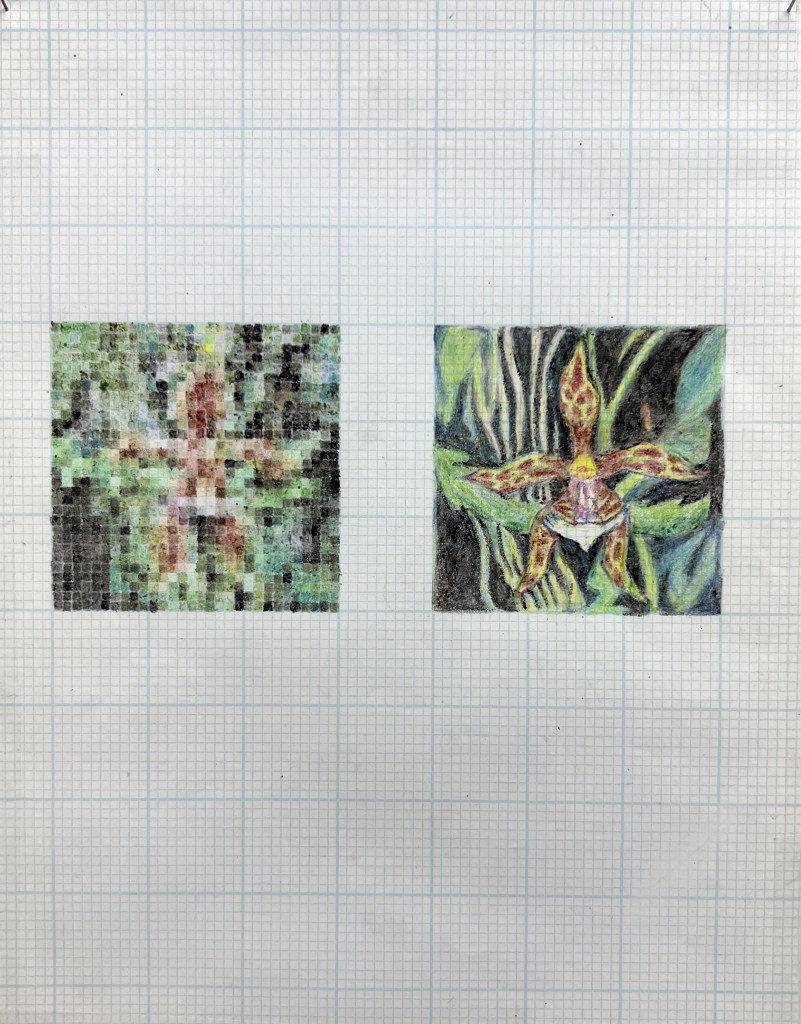
Detail
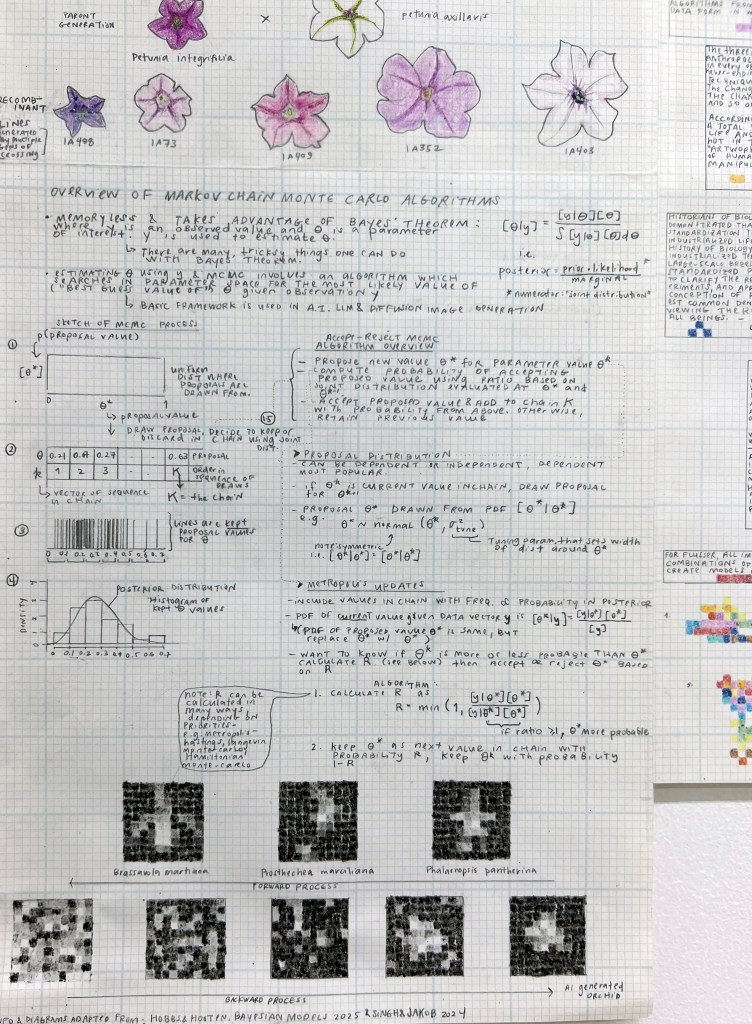
detail
Generating complex and diverse biological forms like orchid flowers is typically the domain of biological processes of reproduction such as natural selection (for example, Darwin’s orchid, Angraecum sesquipedale, whose form evolved in response to an evolutionary relationship with its only pollinator, the sphinx moth Xanthopan morganii xanthopus whose long proboscis (tongue) perfectly matches the orchid’s slender nectary), artificial selection (such as the stunningly diverse range of hybrid orchids created and maintained only through close human intervention), and environmental chance.
This series of diagrams proposes to explore how, and why, new orchid forms might be created with the help of computer vision and machine learning algorithms. In this case, not only is there no biological reproduction involved, there are not even material orchids. Instead, all hybridizing elements are calculated, hybrids are generated using immaterial information stored as zeros and ones, and subsequently assembled into aesthetic forms.
They serve as a launch-point to create experimental work that subverts the boundaries separating the organic-material-biological from the calculable-immaterial-synthetic.
 aubrie's bounce zone